Class 10 Acids, Bases, and Salts – Complete Guide
marketing team / Quizlyapp / Niroop Chand
Understanding acids, bases, and salts is crucial for every Class 10 Science student. These concepts are not only fundamental for board exam success but also play a vital role in real-life applications, from kitchen science to industrial processes. This article brings together key insights from Quizly Talks’ video series based on the NCERT syllabus, offering simple explanations, everyday examples, and memorable facts for effective revision.
What Are Acids and Bases?
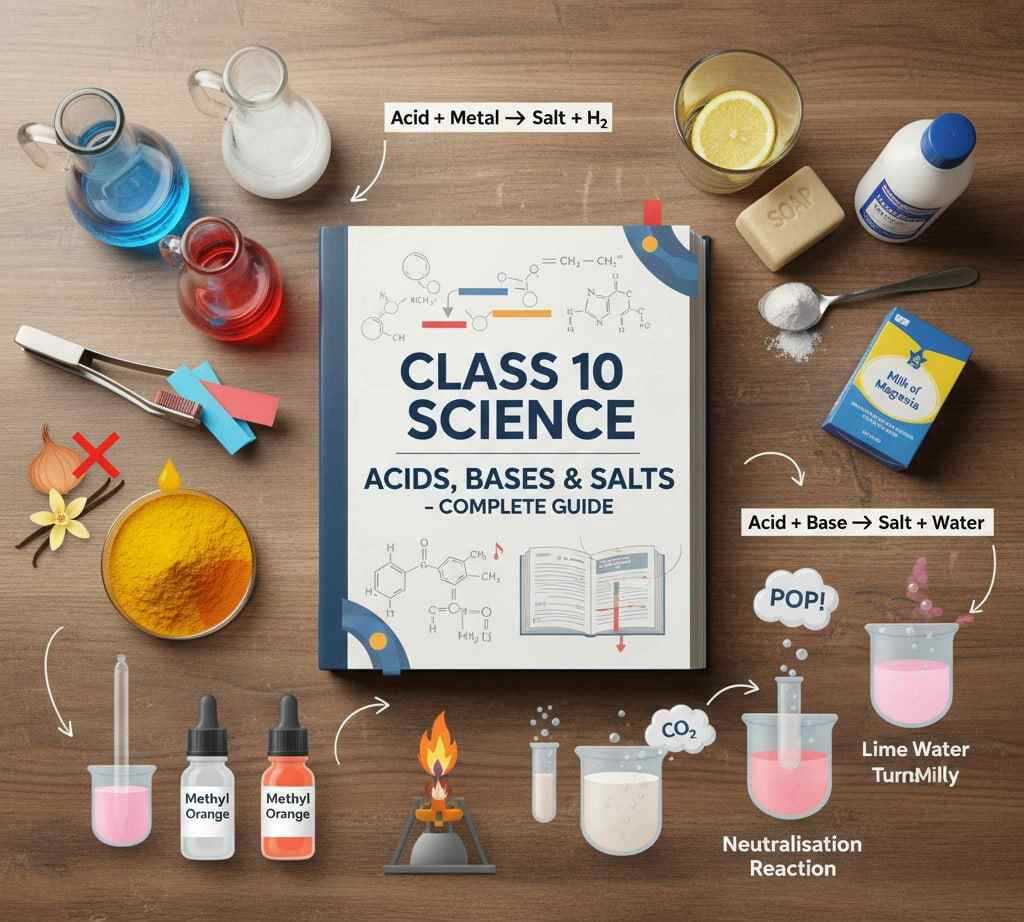
Acids are substances with a sour taste, like lemon juice, vinegar, and tamarind. Bases feel slippery or soapy, taste bitter, and include items such as soap, baking soda, and milk of magnesia. It's important to never taste or touch chemicals in a lab: some acids and bases are corrosive and can cause harm.
Indicators: How We Identify Acids and Bases
Since tasting and touching are unsafe methods, we use indicators, special substances that signal the nature of solutions by changing colour or smell.
Types of Indicators
- Natural Indicators:
- Litmus Paper: Blue litmus turns red in acids; red litmus turns blue in bases.
- Turmeric: Turns from yellow to reddish-brown with bases.
- Olfactory (Smell) Indicators: Onion and vanilla lose their characteristic scent in basic solutions.
- Synthetic Indicators:
- Phenolphthalein: Colourless in acids, pink in bases.
- Methyl Orange: Red in acids, yellow in bases.
Tip: Indicators are used in labs, soil testing, and household cleaning to identify the chemical nature without tasting.
Key Chemical Reactions of Acids and Bases
Knowing how acids and bases react helps you understand how salts are formed and why these reactions matter in daily life and exams.
Important Reactions
- Acid + Metal → Salt + Hydrogen Gas
- Eg: Zinc + Sulphuric Acid → Zinc Sulfate + Hydrogen
- Test for hydrogen: Bring a burning candle, listen for a 'pop'
- Base + Metal → Salt + Hydrogen Gas
- Zinc + Sodium Hydroxide → Sodium Zincate + Hydrogen
- Acid + Carbonate/Bicarbonate → Salt + CO₂ + Water
- Sodium Carbonate + Hydrochloric Acid → Sodium Chloride + CO₂ + Water
- Test for CO₂: Bubble through lime water turns milky.
- Acid + Base (Neutralisation) → Salt + Water
- Hydrochloric Acid + Sodium Hydroxide → Sodium Chloride + Water
- Note: Phenolphthalein turns colourless as the acid neutralises the base.
The Nature of Acids and Bases in Water
All acids release hydrogen ions (H⁺ or H₃O⁺) in aqueous solutions; all bases release hydroxide ions (OH⁻). This property explains why:
- Acids and bases conduct electricity in water.
- Dry HCl shows no acidity; only when dissolved in water does it behave as an acid.
Real-Life Importance and Applications
- Indicators help in agriculture (soil testing), medicine, and environmental science.
- Neutralisation reactions are used in antacid medicines, water treatment, and maintaining pH balance in swimming pools.
- Salts produced, such as sodium chloride (common table salt), play essential roles in food preservation and chemical manufacturing.
CHAPTER 2 PART 1: https://youtu.be/adirId5Potw?si=ASDj6bPj2lJekpuF
CHAPTER 2 PART 2: https://youtu.be/G336jQkcYEQ?si=TQ2iXMZRFziLQR7g
CHAPTER 2 PART 3: https://youtu.be/aeEamOwFuCk?si=pvsOaDY9iCtOxSvQ
CHAPTER 2 PART 4: https://youtu.be/owvqSuvNb3s?si=WHAEvj6opQAUo2At
CHAPTER 2 PART 5: https://youtu.be/3pA89D5kQ04?si=H3gTFaJTjolPCAOv
CHAPTER 2 PART 6: https://youtu.be/A9ixzR2KzxU?si=m8RxSR0miZXb8OJp
Frequently Asked Questions (FAQ)
Q2: Why is it dangerous to taste lab chemicals?A: Many acids/bases are corrosive and toxic.
Q3: What does a neutralisation reaction produce?A: A salt and water.
Q4: Name two natural indicators and their colour change.A: Litmus (blue to red in acid, red to blue in base), Turmeric (yellow to reddish-brown in base).
Q5: What is the result when CO₂ is bubbled through lime water?A: It turns milky due to calcium carbonate formation.
FOLLOW US ON:
INSTAGRAM: https://www.instagram.com/quizly.app/?igsh=cWdrcXRmMXRidWJ2#
YOUTUBE: https://www.youtube.com/@Quizlytalks
LINKEDIN: https://www.linkedin.com/company/quizly-learning/