Ancient Indian Mathematicians Who Shaped Global Knowledge
marketing team / Quizlyapp / Venkateswar rao
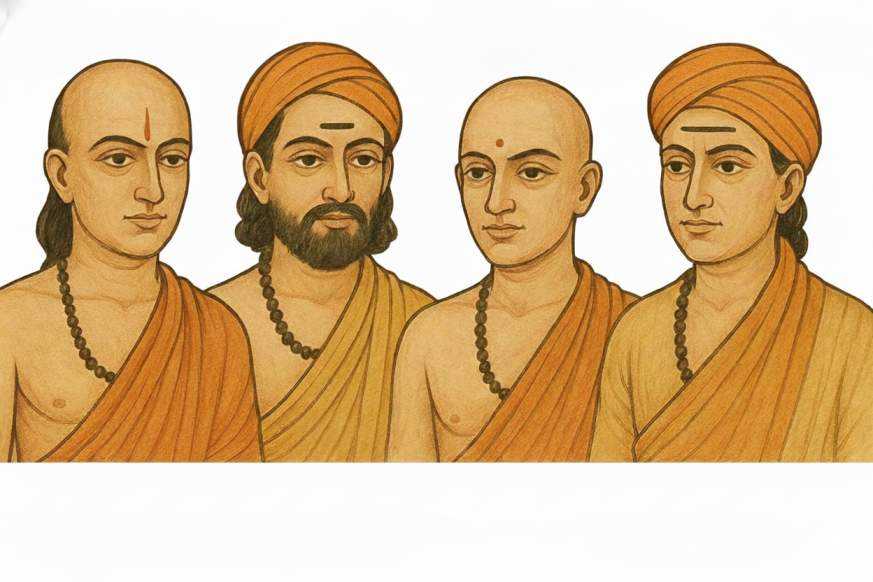
Ancient India’s intellectual legacy transformed global mathematics. Today, the phrase “ancient Indian mathematicians” stands out as a crucial search term and as a testament to innovation that still guides learning worldwide.
India’s scholars gave the world the decimal system, the concept of zero, and pioneering ideas in algebra and trigonometry. Aryabhata, Brahmagupta, and Bhaskara I and II laid the foundation for modern algorithms used in AI and computing.
Aryabhata (476–550 AD)
astonished the ancient world with astronomical calculations, sine tables, and an early place-value system. His algebraic models underpin techniques used in today’s digital data analysis and predictive modelling.
![]()
Bhaskara I and Bhaskara II
expanded on Aryabhata's discoveries, contributing to calculus, algebraic solutions, and geometry. Bhaskara II’s treatise, ‘Lilavati,’ anticipated differential calculus centuries before Newton, influencing mathematical theory worldwide.
India’s mathematicians weren’t just innovative; they were foundational. The Kerala School of Mathematics invented infinite series and early concepts of calculus, impacting global science centuries ahead of European developments.
Brahmagupta (598–668 AD)
revolutionised mathematics by formally introducing zero as a number and the rules for arithmetic with zero. His work with negative numbers and quadratic equations resonates in optimisation methods essential to artificial intelligence.
![]()
Panini (circa 4th century BCE)
Renowned for his Sanskrit grammar, he created one of history’s most complex rule-based language models. His syntactic logic now shapes natural language processing (NLP), AI translation, and machine learning frameworks worldwide.
Jain mathematicians went beyond arithmetic, exploring infinity and combinatorics. Their recursive reasoning and classifying numbers shaped concepts in higher mathematics and future AI optimisation, neural networks, and data science.Ancient Indian logic, such as Navya-Nyaya, laid the philosophical groundwork for computational reasoning and decision trees, the backbone of modern artificial intelligence.
CONCLUSION
The innovations of ancient Indian mathematicians, from zero to algorithms, laid the groundwork for global scientific and technological advancement. Their legacy continues to shape modern AI, data science, and education. Embracing this heritage empowers future generations to drive progress and creativity.
FAQS
Q: Who were the most influential ancient Indian mathematicians?
A: Aryabhata, Brahmagupta, Bhaskara I, Bhaskara II, Mahavira, Varahamihira, and Panini.
Q: What key concepts originated in India?
A: Zero, decimal system, algebra, trigonometry, infinite series, calculus, and advanced grammar models.
Q: How do their ideas affect AI and modern science?
A: Their work shaped algorithms, data processing, computer logic, and natural language processing in today’s AI-driven world.
FOLLOW US ON :
INSTAGRAM:https://www.instagram.com/quizly.app?igsh=cWdrcXRmMXRidWJ2
YOUTUBE:https://www.youtube.com/@Quizlytalks
India’s scholars gave the world the decimal system, the concept of zero, and pioneering ideas in algebra and trigonometry. Aryabhata, Brahmagupta, and Bhaskara I and II laid the foundation for modern algorithms used in AI and computing.
Aryabhata (476–550 AD)
astonished the ancient world with astronomical calculations, sine tables, and an early place-value system. His algebraic models underpin techniques used in today’s digital data analysis and predictive modelling.
Bhaskara I and Bhaskara II
expanded on Aryabhata's discoveries, contributing to calculus, algebraic solutions, and geometry. Bhaskara II’s treatise, ‘Lilavati,’ anticipated differential calculus centuries before Newton, influencing mathematical theory worldwide.
India’s mathematicians weren’t just innovative; they were foundational. The Kerala School of Mathematics invented infinite series and early concepts of calculus, impacting global science centuries ahead of European developments.
Vedic Mathematics, a system of computational shortcuts, introduced mental calculation techniques that inspire efficient algorithms in cryptography and AI today. These lightning-fast approaches unlock new speeds in current data processing.
Brahmagupta (598–668 AD)
revolutionised mathematics by formally introducing zero as a number and the rules for arithmetic with zero. His work with negative numbers and quadratic equations resonates in optimisation methods essential to artificial intelligence.
Panini (circa 4th century BCE)
Renowned for his Sanskrit grammar, he created one of history’s most complex rule-based language models. His syntactic logic now shapes natural language processing (NLP), AI translation, and machine learning frameworks worldwide.
Jain mathematicians went beyond arithmetic, exploring infinity and combinatorics. Their recursive reasoning and classifying numbers shaped concepts in higher mathematics and future AI optimisation, neural networks, and data science.Ancient Indian logic, such as Navya-Nyaya, laid the philosophical groundwork for computational reasoning and decision trees, the backbone of modern artificial intelligence.
Indian innovation didn’t stop with theory; their approaches to resource sharing, academic mentorship, and documenting algorithms mirror best practices in contemporary tech communities and educational platforms.
CONCLUSION
The innovations of ancient Indian mathematicians, from zero to algorithms, laid the groundwork for global scientific and technological advancement. Their legacy continues to shape modern AI, data science, and education. Embracing this heritage empowers future generations to drive progress and creativity.
FAQS
Q: Who were the most influential ancient Indian mathematicians?
A: Aryabhata, Brahmagupta, Bhaskara I, Bhaskara II, Mahavira, Varahamihira, and Panini.
Q: What key concepts originated in India?
A: Zero, decimal system, algebra, trigonometry, infinite series, calculus, and advanced grammar models.
Q: How do their ideas affect AI and modern science?
A: Their work shaped algorithms, data processing, computer logic, and natural language processing in today’s AI-driven world.
FOLLOW US ON :
INSTAGRAM:https://www.instagram.com/quizly.app?igsh=cWdrcXRmMXRidWJ2
YOUTUBE:https://www.youtube.com/@Quizlytalks
LINKEDIN:https://www.linkedin.com/company/quizly-learning/