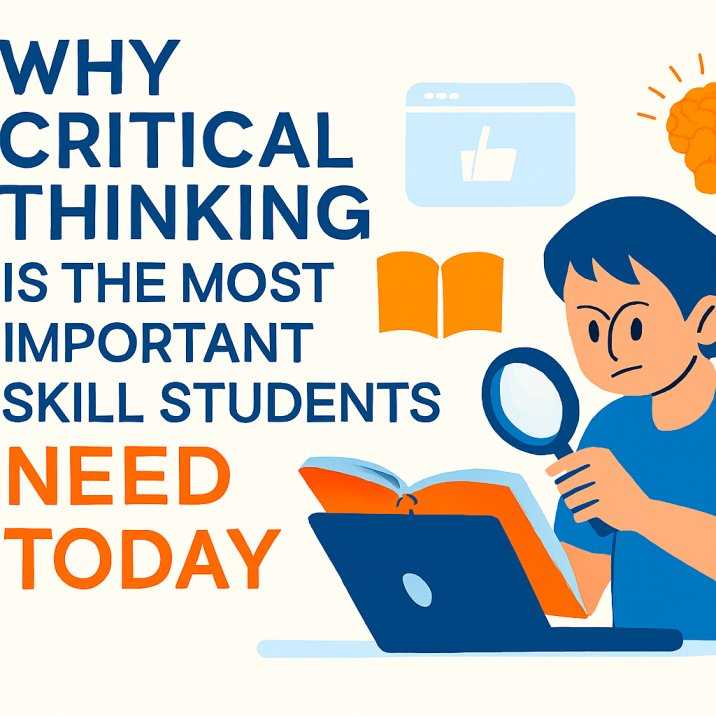
Why Critical Thinking Is the Most Important Skill Students Need Today
marketing team / Quizlyapp / Venkateswar rao
Learn why critical thinking skills matter more than ever in the AI era, how they protect students from misinformation, and how schools and parents can build them daily.
Why Critical Thinking Skills Matter Now
Students today are surrounded by information from textbooks, social media, AI tools, and peers but not all of it is accurate or reliable. Critical thinking skills help students slow down, question sources, and evaluate what to trust instead of accepting the first or loudest answer they encounter. In an age of information overload, thinking clearly matters more than memorising facts.
What “Critical Thinking Skills” Really Mean
Critical thinking is the ability to analyse information, identify assumptions, evaluate evidence, and arrive at logical conclusions that can be clearly explained. It is not about being negative or argumentative, but about being thoughtful, curious, and open to changing one’s mind when better evidence appears. These skills help students move beyond surface-level learning to deeper understanding.
The Link Between Critical Thinking and Student Success
Research consistently shows that students with strong critical thinking skills perform better in problem-solving tasks, complex assignments, and higher-order exam questions. More importantly, they adapt faster to new subjects and unfamiliar challenges because they know how to approach learning, not just how to memorise notes. This adaptability is essential in both academics and real life.
Critical Thinking in the Age of AI
Generative AI can produce essays, solve maths problems, and summarise content in seconds, but it can also sound confident while being incorrect. Without critical thinking skills, students may copy AI-generated answers blindly, miss errors, and gradually lose their own ability to reason, write, and judge quality. AI makes critical thinking more necessary, not less.
Using AI to Strengthen Critical Thinking
When used intentionally, AI can support the development of critical thinking skills. Teachers can ask students to compare AI responses with trusted sources, identify flaws, and improve the reasoning or evidence. This turns AI from a shortcut into a “thinking partner” that students must question, analyse, and refine skills that matter far beyond the classroom.
Classroom Strategies That Build Critical Thinking
Critical thinking grows when students regularly explain why an answer works, discuss alternatives, and reflect on their reasoning. Simple practices like claim evidence reasoning, think–pair–share, Socratic questioning, and analysing real-world case studies can be integrated into any subject without adding extra syllabus load.
Critical Thinking Across All Subjects
Critical thinking skills should not be limited to a single “life skills” period. Maths problems with multiple solution paths, science experiments that require data interpretation, and social-science discussions that examine bias all contribute to a classroom culture where thinking is valued over rote answers.
Benefits Beyond Marks
Students who practise critical thinking gain confidence in expressing ideas because they know how to support opinions with reasons and evidence. These skills also shape responsible citizens who can recognise misinformation, resist manipulation, and participate thoughtfully in civic and digital spaces.
Why Ignoring Critical Thinking Is Risky
When schools focus only on memorisation and shortcuts, students may achieve short-term marks but struggle in higher education, careers, and daily decision-making. In a world of deepfakes, targeted advertising, and AI-generated misinformation, weak critical thinking leaves young people vulnerable to poor choices and false narratives.
FAQS
1. At what age should students develop critical thinking skills?Even young children can start with simple “why” and “how do you know?” questions, with deeper instruction becoming more effective in middle and high school.
2. Does critical thinking reduce exam performance?No. Students who understand concepts deeply usually perform better in application-based and competency-focused exams.
3. How can parents encourage critical thinking at home?By discussing news, stories, and online content, asking children to explain opinions, and consider evidence and alternative viewpoints.
4. Can critical thinking be assessed?Yes. Rubrics, projects, portfolios, and open-ended tasks are commonly used to measure reasoning and decision-making skills.
5. Does using AI harm critical thinking?Only if AI replaces thinking. When students are taught to verify and critique AI output, it can strengthen critical thinking instead.
FOLLOW US ON:
INSTAGRAM:https://www.instagram.com/quizly.app?igsh=cWdrcXRmMXRidWJ2
YOUTUBE:https://www.youtube.com/@Quizlytalks
LINKEDIN:https://www.linkedin.com/company/quizly-learning/